
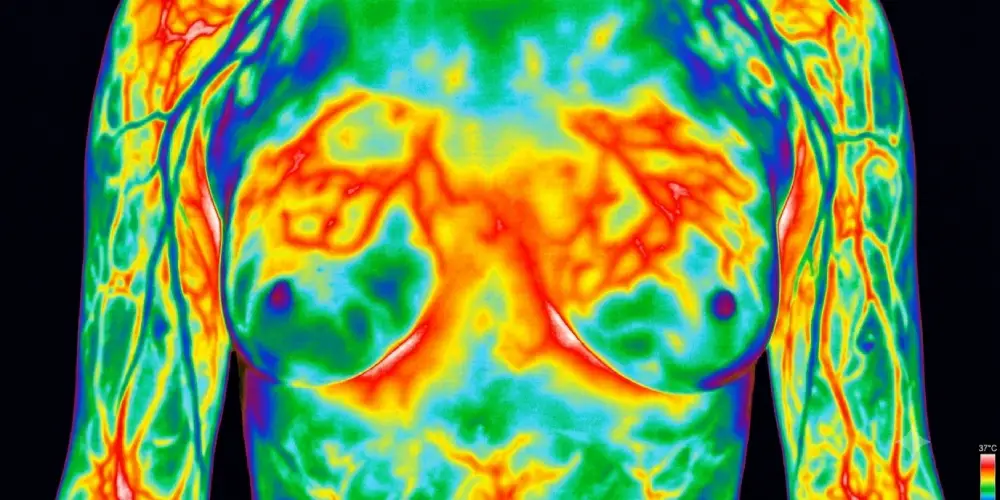
Breast health is not something that should only enter the conversation when a symptom appears. Many people want a clearer picture of what is happening in their bodies and are looking for ways to stay informed between routine appointments. Breast thermography offers one way to do that. It uses infrared technology to record heat patterns at the surface of the body, giving us physiological information rather than a picture of breast structure. At our thermography clinic in San Marcos, we use this information as a complementary tool, helping patients understand another aspect of their breast health while keeping established screening methods firmly in the picture.
What Is Breast Thermography?
Breast thermography is a non-invasive imaging technique that examines temperature patterns in the breast and surrounding tissue. These patterns are recorded with no contact to the body, no radiation, injections, or compression, by a specialized infrared camera. The photos produced may have variances in surface temperature and asymmetry patterns. These patterns might be related to circulation, inflammation, or other physiological processes. That difference matters. Thermography is not looking for a bulk or trying to identify cancer from an image; it is looking at heat and physiological activity.
How Does Breast Thermography Work?
The appointment itself is fairly simple, but the conditions around the imaging matter. We capture thermal images in a controlled environment because outside temperature, recent physical activity, skin products, and other factors can affect surface temperature. Patients are given preparation instructions before the appointment for this reason. Once the images are captured, they can be reviewed for patterns that may deserve monitoring or further discussion. The value is not in treating one unusual temperature difference as an answer. It is in putting the image into context and, when appropriate, comparing it with future examinations.
How Can Thermography Support Breast Health?
A beneficial feature of thermography is that a baseline may be established. A single thermal image gives us a snapshot of what the temperature patterns look like at one moment in time. Follow-up photos can reveal if such patterns remain the same or change. That contrast might give context when talking about breast health with a health care expert. At the same time, it is crucial to be explicit about what we may learn from thermography. It is not a diagnostic test for breast cancer, nor is it a replacement for mammography, ultrasound, MRI, or a clinical breast exam. We think it is an ancillary tool that may offer extra physiological information in the setting of proper medical care.
What Should You Expect During an Appointment?
If you are considering breast thermography in San Marcos, CA, the first thing to know is that the imaging itself is noncontact. There is no breast compression and no injection involved. We follow established imaging procedures and focus on obtaining clear, consistent thermal images. Preparation is an important part of that process, so patients may be asked to avoid certain activities or products before the appointment. Something as ordinary as vigorous exercise or exposure to significant temperature changes can temporarily affect skin temperature, which is why following the preparation guidance can make a real difference in image quality.
Why Is a Baseline Useful?
A baseline gives future examinations something to be compared against. This is particularly relevant because thermal patterns can vary from person to person, and a finding that looks unusual in isolation does not necessarily mean something is wrong. Looking at changes over time can provide more useful context. If a notable change appears, the appropriate response is not to diagnose the cause from the thermal image. Instead, it may be a reason to speak with a qualified healthcare professional and determine whether another form of evaluation is appropriate.
What Can Affect a Thermography Image?
Thermal imaging is sensitive to conditions that can temporarily change the temperature of the skin. That is why preparation is more than a formality. Depending on the examination, factors that may matter include:
● Recent strenuous exercise
● Exposure to very hot or cold environments
● Certain lotions, creams, or deodorants
● Activities that increase circulation
● Other preparation factors provided by the clinic.
Following the instructions before an appointment helps create conditions that are as consistent as possible, which makes the resulting images more useful for assessment and comparison.
How Does Thermography Fit Into Breast Care?
We see breast thermography as one piece of a much larger picture. Traditional breast screening methods examine physical structures and remain important for detecting and evaluating abnormalities. Thermography approaches the body differently by recording surface heat patterns and physiological changes. Those are not interchangeable forms of information, and treating them as though they are would create an inaccurate picture of what the technology does. Used appropriately, thermography can complement other forms of care and give patients another point of information to discuss with their healthcare providers.
Is Breast Thermography Right for Everyone?
There is not one-size-fits-all breast health plan. Screening decisions take into account a number of aspects including: age, personal and family history, symptoms, previous findings, and advice from a healthcare expert. If you are interested in thermography, it is worth knowing both what it can do and what it cannot do before you add it to your routine. We encourage patients to continue with recommended medical tests and assessments, and to consider if thermal imaging has a beneficial position alongside them.
Conclusion
Knowing what a test actually measures makes it easier to decide whether it belongs in your personal approach to health. Thermography provides a noninvasive way to document surface temperature patterns and observe those patterns over time, but its role is complementary rather than diagnostic. At our thermography clinic in San Marcos, we help patients understand the imaging process and what thermal imaging can realistically contribute. If you would like to learn more, please contact us at View of Health Thermography to discuss preparation, the appointment procedure, and whether thermography may complement the breast health treatment you presently receive.
FAQs
Breast thermography uses infrared imaging to record surface temperature patterns across the breasts.
No, breast thermography is a noncontact procedure that requires no compression or injections.
Follow the clinic’s preparation instructions and avoid activities or products that may affect skin temperature.
A baseline provides a reference for comparing thermal patterns during future examinations.
No, thermography is complementary and should not replace mammography or other recommended breast screenings.
